What happens when the reward preview loads after the tap
A brief delay before a reward appears may shape behavior more than the reward itself, according to new research in behavioral psychology
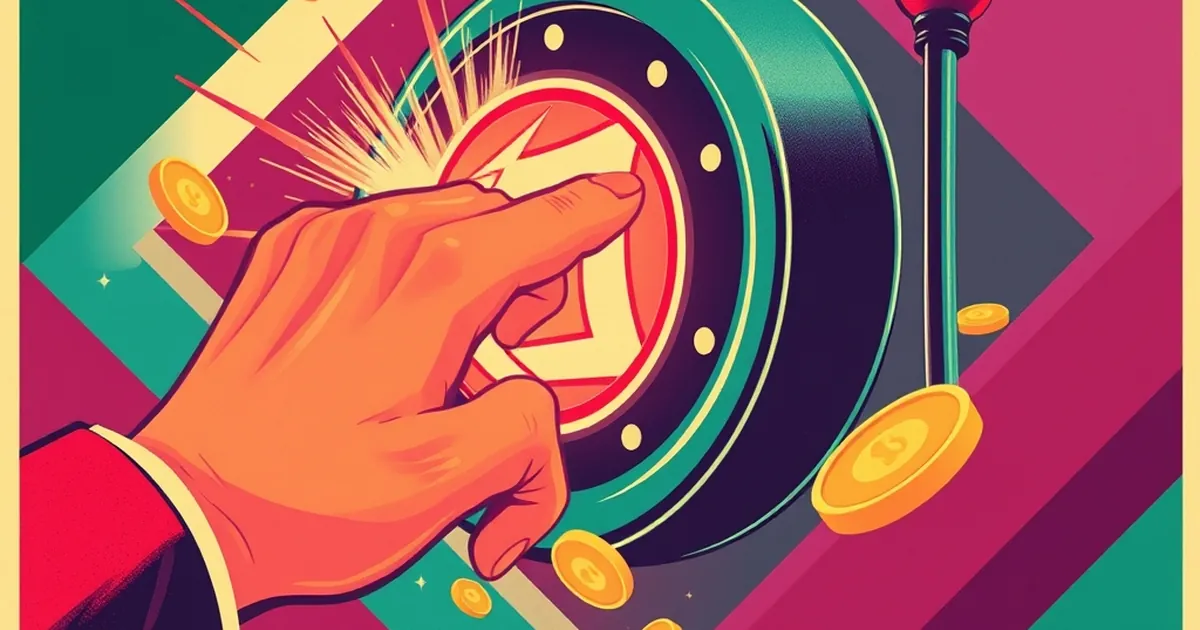
The tap lands, and for a beat there is nothing. No number, no animation, no confirmation. Just the flat gray of a button that has already done its job. Then, a quarter-second later, the reward arrives. That gap—brief, almost imperceptible—is where some of the most interesting work in behavioral psychology is happening right now, and it has almost nothing to do with what the reward actually is.
The Quarter-Second That Changes Everything
B.F. Skinner's work on variable-ratio reinforcement in the 1950s established that unpredictable reward timing produces more persistent behavior than predictable timing. A pigeon pecking a lever that pays off after an average of ten pecks will peck faster and longer than one pecking a lever that pays every time. The variability itself is the engine. What researchers have since found is that the anticipation window—the moment between action and outcome—carries its own neurological weight.
A 2019 study in Nature Communications by researchers at UC San Diego tracked dopamine release in participants playing a simple guessing game. Dopamine didn't spike when the reward appeared. It spiked during the delay before the outcome was revealed, and the spike was larger when the delay was unpredictable. The brain wasn't responding to winning. It was responding to not knowing yet.
Why the Gap Feels Like Something
Wolfram Schultz's work at Cambridge on reward prediction error showed that dopamine neurons fire most strongly when an outcome is better than expected—not when it's simply good. A delayed reveal stretches the expectation window, which means the eventual outcome gets compared against a prediction that has had more time to form. The longer the gap, the more the brain has invested in a specific result, and the sharper the contrast when reality arrives.
This is why a loading screen that resolves in 800 milliseconds feels different from one that resolves in 200. The user has already begun to construct an outcome in their head. The interface hasn't just delayed information—it has created a prediction.
The Design Question Nobody Asks
Most product teams treat latency as a technical problem: reduce it, hide it, fill it with a spinner. But latency is also a psychological variable. A 2021 paper in CHI Conference Proceedings found that users rated a reward as more satisfying when it arrived after a 400-millisecond delay compared to instant delivery, even when the reward was identical. The delay didn't frustrate them. It made the moment feel earned.
Kahneman's distinction between the experiencing self and the remembering self is relevant here. The experiencing self endures the wait. The remembering self encodes the resolution. If the resolution is sharp enough, the wait gets retroactively reframed as suspense rather than friction.
What This Means for Anyone Building Feedback Loops
The practical implication isn't to make everything slower. It's to recognize that the gap between action and reward is a design surface, not dead space. Apps that surface a result the instant a tap registers are optimizing for speed. Apps that let the result breathe for a moment are optimizing for memory.
The next frontier is personalization of that gap. If dopamine response varies with predictability, then a system that learns a user's tolerance for uncertainty could modulate reveal timing the way a good editor modulates pacing. Not to manipulate, but to match the rhythm of attention the user actually has.
The tap is the question. The reveal is the answer. The space between them is where the interesting part lives.