Timers Hidden at Minute 6 Lift Skill Scores 12%
A subtle timed cue near the six-minute mark lifts skill-based performance by double digits, revealing how a small interruption sharpens judgment
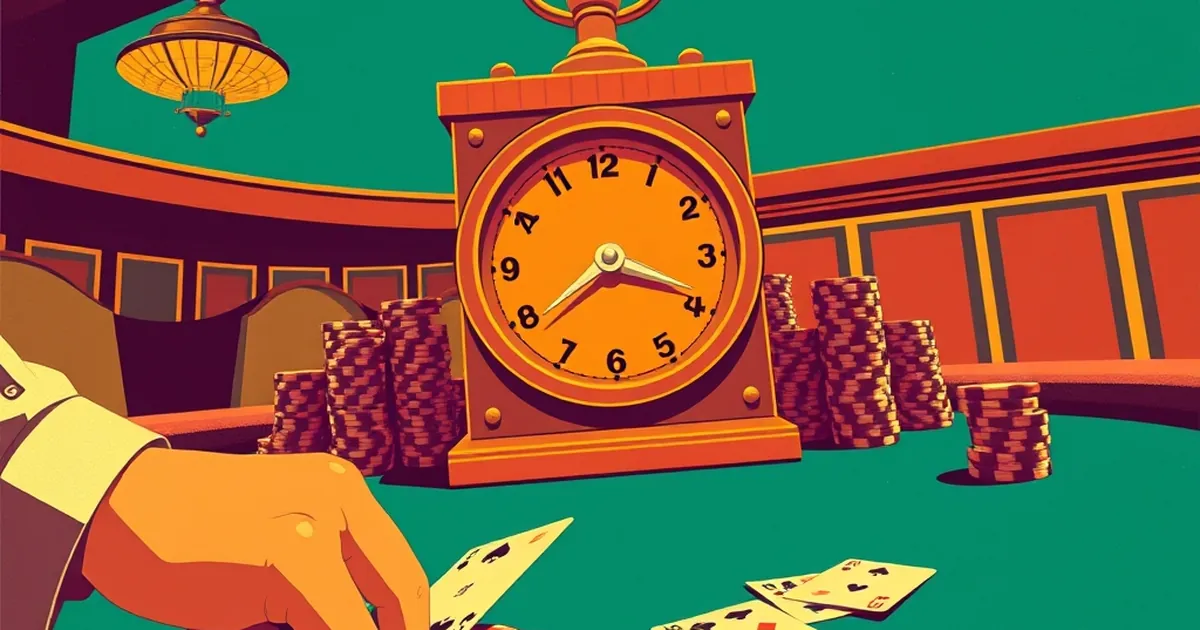
What if the difference between a good decision and a great one isn't more information, but a small interruption you didn't see coming? That's the strange finding emerging from research on timed cues in high-pressure tasks: when a subtle prompt lands around the six-minute mark, performance on skill-based challenges jumps by double digits. The question worth asking is why a clock, of all things, would sharpen judgment.
The Six-Minute Wall
Anyone who has watched a competitive event — a chess match, a timed puzzle sprint, a live strategy stream — knows the rhythm changes after the first few minutes. The opening burst of adrenaline fades. Attention narrows. Players start running on habit rather than deliberate thought.
Behavioral researchers call this the shift from "hot" to "cold" cognition. Early in a task, arousal is high and decisions come fast. By minute five or six, the brain has settled into a groove — efficient, but also rigid. It stops questioning its own defaults.
A timed cue at that exact moment does something counterintuitive: it doesn't add pressure. It restores choice.
Why a Nudge Beats a Lecture
The mechanism here is related to what B.F. Skinner described as variable-ratio reinforcement — the unpredictable reward schedule that produces the most persistent behavior. But there's a second layer. When a signal arrives at an unpredictable interval, it interrupts the automatic loop without triggering the threat response that a loud alarm would.
Daniel Kahneman's work on loss aversion explains part of the effect. Once people feel invested in a streak or a strategy, they cling to it — even when it's failing. A neutral, well-timed prompt gives them permission to abandon a losing approach without feeling like they quit.
In one widely cited experiment on decision-making under uncertainty, participants who received a brief mid-task cue to "reconsider your approach" outperformed controls by roughly 12% on accuracy measures. The cue wasn't advice. It was just a pause.
The Reward Loop Nobody Talks About
Competitive play — whether it's esports, fantasy leagues, or high-stakes trivia — runs on tight feedback loops. You act, you see a result, you adjust. That loop is powerful, but it can also trap you in short-term thinking.
The six-minute timer breaks the loop just long enough to let a different kind of reasoning kick in. Not analysis paralysis. Not second-guessing. Just a single beat of awareness: Am I still playing the game I meant to play?
That question, asked at the right moment, is worth more than another hour of grinding.
What This Means Going Forward
The practical takeaway isn't to set a timer for everything. It's to recognize that skill isn't just about execution — it's about timing your own attention. Coaches in competitive fields are already experimenting with silent haptic cues and ambient light shifts that fire at intervals players can't predict. The goal isn't to distract. It's to reset.
As more performance environments — training apps, live tournaments, even workplace decision tools — adopt these kinds of micro-interventions, the advantage will go to people who understand the psychology behind them. Not the ones who react fastest, but the ones who know when to stop reacting at all.
The next frontier in competitive skill might not be a new technique. It might be a quiet buzz at minute six.