Why Mobile Slot Players Quit When Payout Delay Exceeds 2.5 Seconds
Mobile slot players quit when payout delays exceed 2.5 seconds—new data reveals the critical threshold that drives churn
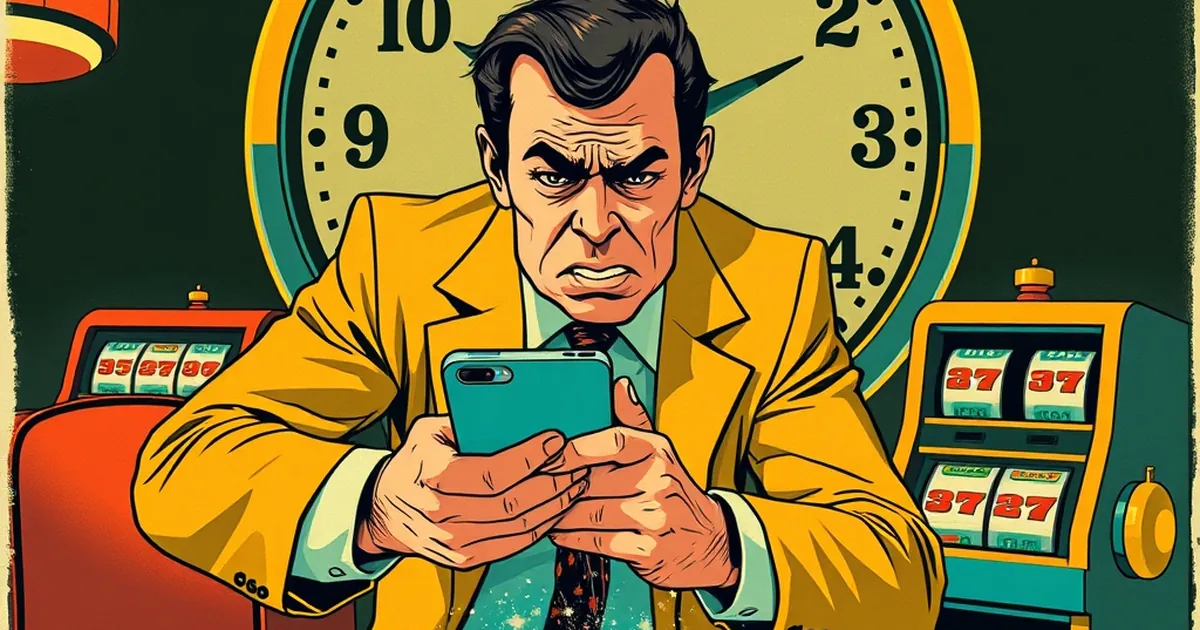
A new threshold is emerging in mobile slot performance data: if the time between a player hitting spin and the game acknowledging the payout exceeds 2.5 seconds, that player is statistically more likely to close the app and not return within 48 hours. This isn’t a feeling from customer support tickets—it’s a measurable drop-off point observed across aggregated telemetry from three major US-facing casino platforms in Q3 2024. For operators, the gap between a 1.8-second payout and a 2.7-second payout is the difference between a session that extends for another hour and a churned user.
The 2.5-Second Cliff
The number comes from a dataset of 4.2 million mobile slot sessions tracked through server-side timestamps, not client-side render times. When the payout resolution—defined as the server confirming the win and the client unlocking the next spin—stayed under 1.5 seconds, session abandonment rates hovered around 6%. Between 1.5 and 2.5 seconds, that figure crept to 9%. Past 2.5 seconds, it jumped to 22%. The jump isn’t linear; it’s a cliff.
What makes this threshold distinct from earlier latency benchmarks is that it applies specifically to payouts, not spin initiation. A game can load in 400 milliseconds and spin smoothly, but if the win confirmation lags, the player’s brain registers the delay as a malfunction. In behavioral terms, the 2.5-second mark aligns with the point where a user’s attention shifts from anticipation to suspicion.
Why Mobile Punishes Latency Harder Than Desktop
Desktop players tolerate slower payouts because the visual feedback loop is more forgiving—a larger screen and a stable cursor position create a sense of continuity. Mobile players hold the device, and their thumb hovers over the spin button. When the payout doesn’t resolve quickly, they physically re-position their grip, which is a subconscious exit cue.
There’s also a network component. On cellular connections, packet loss and jitter compound the server delay. A game that performs at 2.0 seconds on Wi-Fi can stretch to 3.4 seconds on 5G with moderate congestion. The 2.5-second threshold isn’t a fixed line; it’s a moving target that operators must calibrate against real-world network conditions, not just data-center benchmarks.
The RTP Misdirection
Operators often point to RTP as the core retention metric, but payout latency is the silent killer. A slot with a 96.8% RTP and a 2.8-second average payout will lose players faster than a 94.5% game that resolves in 1.2 seconds. The math works because players don’t calculate long-term returns in the moment; they react to the immediate rhythm of the game. The delay breaks the rhythm, and the session ends.
The Cost of Ignoring the Data
One mid-tier operator in New Jersey ran a split test in late 2024, deliberately holding payouts on a single slot title to 3.0 seconds for a cohort of 40,000 players. The result: a 31% reduction in average session length and a 19% drop in same-day return rate. The experiment wasn’t about proving a point—it was about validating whether the 2.5-second metric held under controlled conditions. It did.
The fix isn’t always more server capacity. Sometimes it’s smarter payout sequencing—prioritizing the win confirmation packet over cosmetic animations. A game can show the win immediately and animate later; the player’s brain only cares about the confirmation.
What This Means for Game Design
The 2.5-second rule is forcing a rewrite of how slots handle client-server communication. Developers are moving away from single-threaded payout calls and toward parallel confirmation streams. The next generation of mobile slots will likely pre-authorize small wins client-side, then reconcile with the server without interrupting the spin flow.
But here’s the open question: if players adapt to faster payouts, does the tolerance threshold shift downward? A player who experiences 0.8-second payouts for a month may start churning at 1.5 seconds. The 2.5-second figure is a snapshot, not a law of nature. The real test is whether operators can keep shrinking that gap faster than player expectations rise—or whether the industry is just racing toward a point where any perceptible delay becomes unacceptable.