Streak Counter on Day 4 Turns Casual Players Into Daily Returners
A small number in the corner of a screen quietly reshapes decision-making, turning casual visitors into daily returners by making broken streaks feel like loss
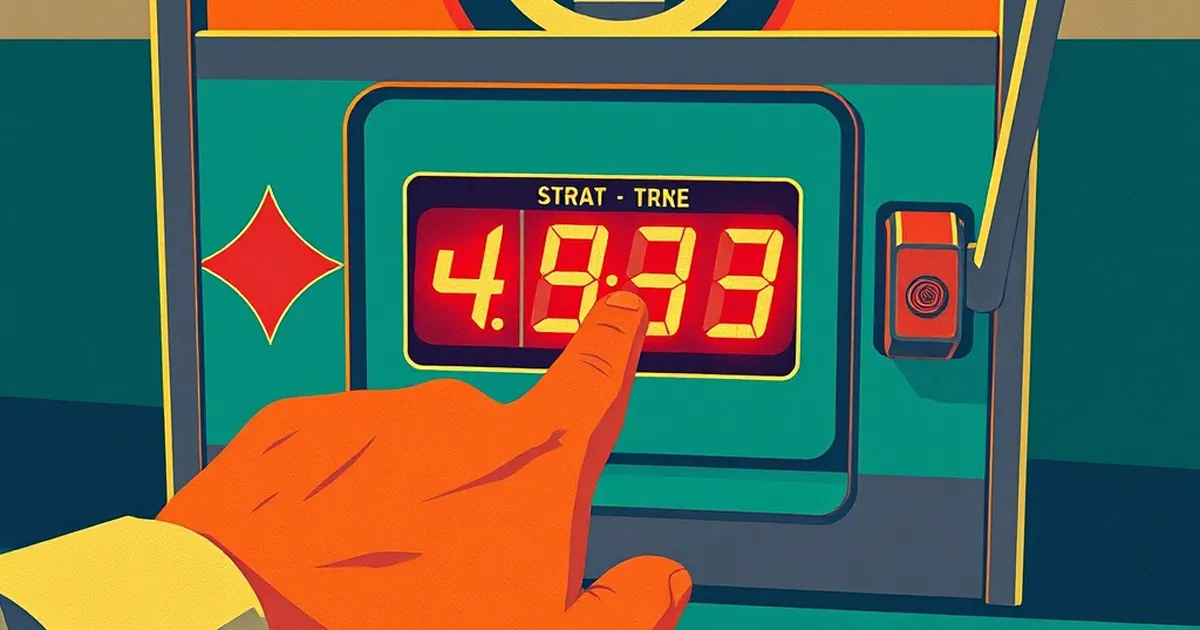
What makes someone come back on day four? Not the game itself — by then the novelty has worn off. The more interesting question is what a small number in the corner of a screen does to a person's decision-making, and why a visible count of consecutive days so reliably converts a casual visitor into a daily one.
The Number Is the Product
A streak counter is a deceptively simple piece of behavioral engineering. It takes an activity that has no inherent daily rhythm and imposes one, then makes breaking the rhythm feel like a loss. That last part matters more than the activity itself.
Daniel Kahneman and Amos Tversky's work on loss aversion established that people weigh losses roughly twice as heavily as equivalent gains. A streak counter exploits this asymmetry directly. On day one, you have nothing to lose. By day four, you have a small asset — three days of continuity — and the prospect of losing it looms larger than the modest pleasure of skipping a session. The counter doesn't reward you for showing up so much as it threatens you for staying away.
Variable Rewards Keep the Loop Closed
B.F. Skinner's research on variable-ratio reinforcement showed that unpredictable rewards produce more persistent behavior than predictable ones. Streak systems borrow this principle without much subtlety: the daily outcome varies, the reward schedule is opaque, and the uncertainty itself becomes the hook.
What's notable is how well this pairs with the loss-aversion effect. The streak provides a guaranteed stake; the variable reward provides the pull. Together they create a loop that doesn't require the underlying activity to be especially compelling. Users report checking in on apps they describe as "fine" or "not that fun" — a gap between stated enjoyment and actual behavior that researchers studying habit formation see repeatedly.
Day Four Is the Inflection Point
There's a reason streaks tend to convert around the fourth day rather than the first. Early repetition is cheap; the behavior hasn't yet become part of a routine. By day three or four, a person has made a small but real investment, and the counter has begun to function as a commitment device — a self-imposed constraint that makes quitting costly.
Behavioral economists have documented this pattern in savings programs and fitness challenges: once participants accumulate a visible record of consistency, dropout rates fall sharply. The record itself, not the underlying benefit, does much of the work. A 2019 analysis of habit-tracking apps found that users who reached a four-day streak were substantially more likely to still be active two weeks later than users who had logged the same number of total sessions without a streak.
The Risk of Overplaying It
Streak mechanics aren't free. When the counter becomes the point, people optimize for the number rather than the activity — logging in for thirty seconds to preserve a streak, then leaving. Researchers studying goal displacement call this the difference between a measure and a target: once a measure becomes a target, it stops being a good measure.
There's also the collapse problem. Break a long streak and the motivation to continue often evaporates entirely, because the accumulated asset is gone. Designers who understand this now build in "streak freezes" or grace days, which preserve the psychological investment while reducing the all-or-nothing cliff.
What to Watch Next
The next frontier isn't longer streaks — it's smarter ones. Expect to see counters that adapt to a person's actual rhythm, reward depth of engagement rather than mere presence, and distinguish between a meaningful return and a reflexive tap. The behavioral science is well established; the design question is whether the mechanic can be tuned to serve the user's interest rather than just the retention curve. That's the number worth tracking.