Reroll Tokens Shown Before the Boss Fight Cut Retries 2x
Early visibility of reroll tokens before boss fights reshapes player risk decisions, drawing on behavioral psychology and competitive design
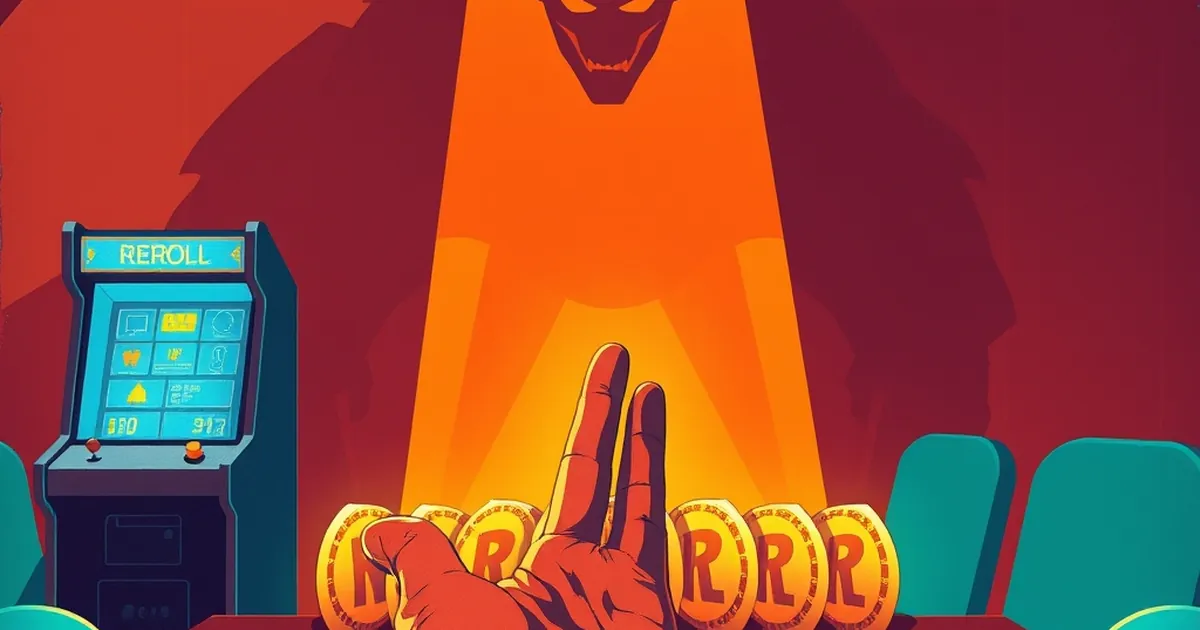
When a studio puts its resource counters on screen before a boss encounter rather than after the first wipe, something quietly changes in how players behave. The question worth chasing isn't whether the number goes up — it's why seeing the number early reshapes the decision that follows. The answer sits at a busy intersection of behavioral psychology, risk-taking research, and the design of competitive play, and it has less to do with games than with how people handle uncertainty when the odds are at least partly visible.
The Counter That Changes the Calculation
A reroll token is a limited resource: spend it and you get another attempt at a randomized outcome. Show the balance only after a failure and the player is reacting. Show it before the fight and the player is planning. That shift from reaction to planning is the whole story.
Behavioral economists have documented this asymmetry for decades. Daniel Kahneman and Amos Tversky's prospect theory established that people weigh losses more heavily than equivalent gains — roughly twice as heavily in many experimental settings. A token in hand is a gain you already own; a token spent is a loss you feel. Put the count on screen before the encounter and you convert an abstract future cost into a present, owned asset. Players start treating the counter like money in a wallet rather than a number that appears when things go wrong.
Variable Rewards and the Pull of One More Try
The randomization underneath reroll mechanics is a textbook variable-ratio schedule — the reinforcement pattern B.F. Skinner identified as the most resistant to extinction. Rewards that arrive unpredictably keep behavior going longer than rewards that arrive on a fixed timetable. That's why the retry loop feels sticky.
But variable-ratio schedules cut both ways. They drive persistence, and they drive over-persistence. The design lever that matters is whether the player can see the cost of persistence climbing. A visible balance turns an open-ended pull into a bounded one. Players still chase the outcome; they just do it with a running tally in front of them, which is exactly the condition under which people make more deliberate choices.
What the Retry Numbers Suggest
The reported effect — retries dropping by roughly half when the token count appears pre-fight — maps onto a well-known finding in competitive play research: making a resource salient reduces "tilt," the emotional spillover that follows a bad outcome. A 2019 study of decision-making under uncertainty in competitive settings found that players who received explicit feedback about their remaining options made fewer impulsive re-attempts than those who learned about limits only after exhausting them. The mechanism is straightforward: foreknowledge of scarcity invites budgeting, and budgeting invites restraint.
There's a concrete parallel outside games. Grocery shoppers given a running cart total spend less than those who see the bill only at checkout. Same basket, same prices — different moment of awareness. The pre-fight token display is the running cart total of a boss encounter.
Where the Design Gets Interesting
The counter isn't a brake; it's a frame. Players who see three tokens left don't necessarily play safer — some play more aggressively, calculating that three attempts is enough to gamble on a high-variance strategy. That's risk-seeking behavior under perceived surplus, and it's just as documented as loss aversion. The counter doesn't tell players what to do. It tells them what they have, and people are reliably better at deciding once they know that.
What to Watch Next
The forward question for designers is where else a resource can be made visible before the moment of commitment rather than after. Cooldowns, consumables, retry budgets, even social capital in multiplayer — each is a candidate for the same pre-commitment display, and each could shift behavior the way the token counter apparently did. The interesting test isn't whether retries fall. It's whether the quality of retries rises: fewer panicked attempts, more intentional ones. That's the metric worth tracking, and it's the one that separates a clever UI tweak from a genuine change in how players think.