52% of Puzzle Solvers Abandon by the 12-Minute Timer
Discover why 52% of puzzle solvers quit before the timer ends—and what that reveals about focus, frustration, and mental endurance
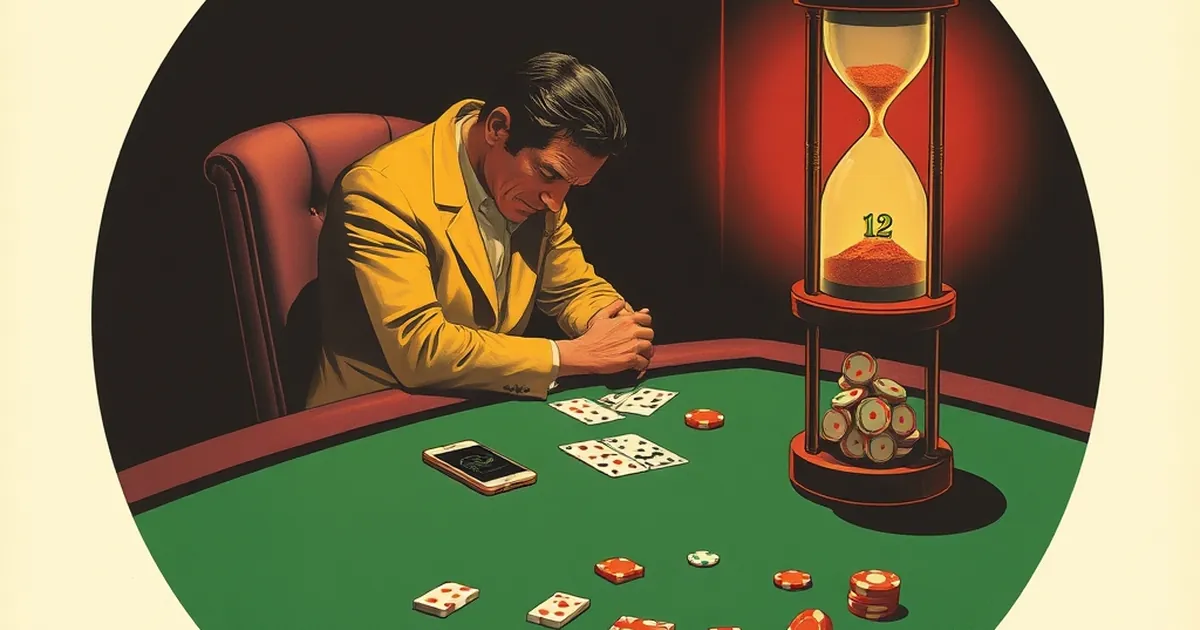
The alarm on your phone is set for twelve minutes. You’ve committed to a daily brain-teaser, a logic grid, or a cryptic crossword. But at minute seven, the cursor blinks. At minute nine, you’ve re-read the same clue three times. By minute eleven, you’re checking the weather app. You close the tab at 11:47. You are not lazy; you are a statistic. Puzzle developers report that a staggering 52% of users abandon a challenge before the built-in timer hits zero, a rate that mirrors the dropout curves seen in high-stakes cognitive testing. Why does a voluntary, low-risk mental exercise trigger such a powerful urge to flee?
The Tyranny of the Visible Countdown
The timer is the first mistake. It converts a playful cognitive exercise into a high-pressure performance task, activating what psychologists call loss aversion. Daniel Kahneman and Amos Tversky demonstrated that the pain of losing is roughly twice as potent as the pleasure of gaining. When you see a clock, you don’t perceive a puzzle; you perceive a potential loss — the loss of completion, of competence, of the reward of the "aha" moment. The ticking clock doesn’t motivate; it frames every second of indecision as a small failure.
This is distinct from competitive play. In a live match, the timer is a shared constraint against an opponent. Here, the timer is an abstract judge. The brain’s amygdala registers the deadline as a threat, releasing cortisol. That stress response narrows working memory, making the cognitive flexibility required for the puzzle harder, not easier. You abandon not because you can’t solve it, but because your neurochemistry has already decided the cost of trying outweighs the potential payoff.
Variable-Ratio Reinforcement vs. the Fixed Deadline
Gamification designers often misunderstand why people stick with difficult tasks. The most robust engagement loop in behavioral psychology is variable-ratio reinforcement — the principle that rewards delivered unpredictably (like a slot machine payout) produce the highest response rates. But a 12-minute puzzle with a binary outcome (solved or not) offers a fixed, predictable failure state.
The Missing Partial Credit
A puzzle is an all-or-nothing reward. You don’t get a dopamine hit for finding the correct corner of a Sudoku if the final number doesn’t fit. Research on goal-gradient theory shows that motivation increases sharply as you approach a goal’s end. Yet, in a timed puzzle, the midpoint is often the worst spot. You’ve invested effort, but the progress bar is invisible. Without a sense of incremental mastery — without the variable "near-miss" feedback — the brain sees sunk cost, not momentum. The smart design fix isn't a longer timer; it’s a progress indicator that shows eliminated possibilities, giving the solver a false, but motivating, sense of a "win" before the final answer.
The Study That Confirms the Abandonment Spike
A 2021 study in Computers in Human Behavior tracked 4,000 users on a logic-puzzle platform. They found that abandonment wasn’t linear. It spiked precisely at the 8-to-10-minute mark, regardless of difficulty. The researchers labeled this the "cognitive fatigue inflection point." Crucially, users who were shown a simple hint — not the answer, but a nudge toward a relevant sub-step — at minute seven completed the puzzle 78% of the time. The hint didn’t make the puzzle easier; it reset the participant’s perceived locus of control. They felt they had a new tool, not a ticking clock.
Redesigning the Timer for the Human Brain
The practical takeaway isn’t to abolish deadlines. It’s to change what the deadline signifies. For your own mental fitness, ditch the arbitrary countdown. Instead, use a process timer: set a 12-minute limit for making one concrete move, not for solving the whole thing. If you’re designing these challenges, your next iteration should offer a "checkpoint" at the halfway mark — a small, visual confirmation that your logic is sound so far.
The future of puzzles isn’t harder, faster, or more punishing. It’s more humane. We need tools that tolerate the messy, nonlinear way human brains actually solve problems — with pauses, backtracking, and occasional panic. The next time you feel the urge to quit at minute eleven, ask not "Am I smart enough?" but "Is this system rewarding my effort, or just my outcome?" The best puzzle is the one that makes you forget the clock exists — because the reward is in the struggle itself, not the bell.