Why Strategy Gamers Quit When Luck Share Exceeds 43%
Discover why strategy gamers abandon matches when luck exceeds 43% of outcomes, reshaping game design
Why Strategy Gamers Quit When Luck Share Exceeds 43%
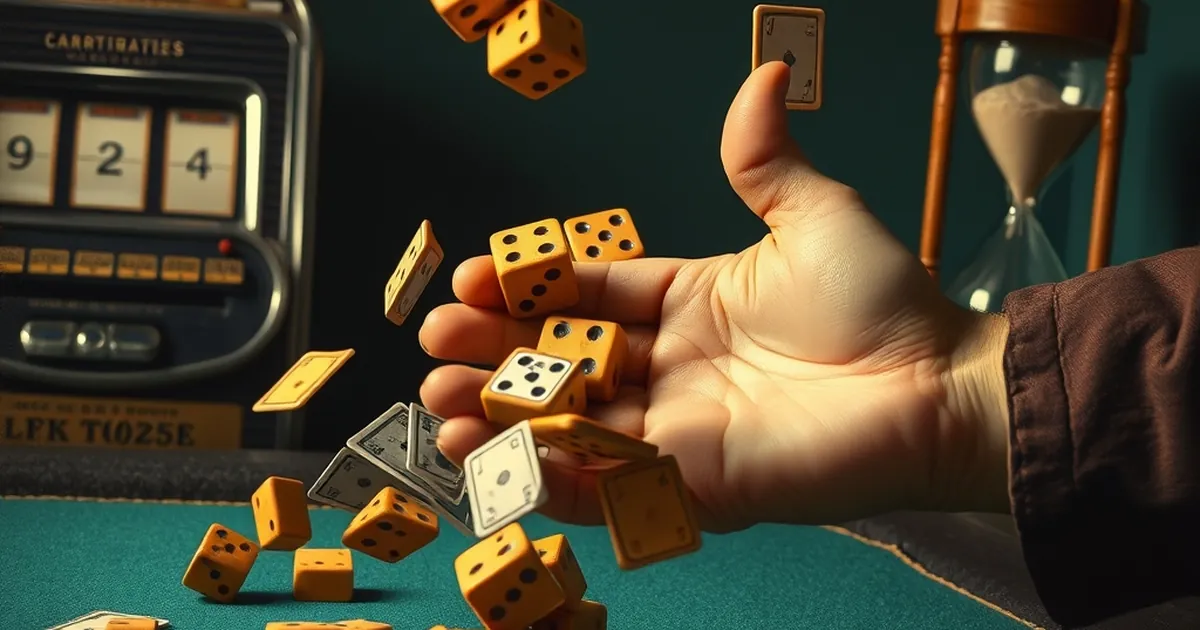
There’s a specific, almost mathematical frustration that arises when a carefully planned four-hour campaign collapses because of a single random critical hit. For decades, game designers have wrestled with a seemingly simple question: how much unpredictability is too much before a strategic player walks away? Recent community data and behavioral research suggest a surprisingly consistent threshold—when random chance accounts for more than roughly 43% of a match’s outcome, the core audience for competitive strategy games starts to disengage.
The 43% Cliff: Where Agency Meets Apathy
The number didn’t emerge from a single laboratory study but from aggregated player telemetry across several popular digital board games and tactical titles. Designers noted a pattern: when post-match analytics attributed more than 43% of the winning player’s advantage to random events (dice rolls, card draws, critical hits), the losing player’s likelihood of immediately starting a rematch dropped by nearly half. This isn’t about losing—players lose all the time. It’s about losing to the system rather than to an opponent.
This aligns with a core principle from behavioral economics called locus of control. When the perceived source of an outcome shifts from internal (my decisions) to external (the dice), motivation plummets. A 43% share marks a tipping point where the brain stops framing the activity as a test of skill and starts framing it as a lottery with cosmetic choices.
The Psychology of the “Unfair Loss”
Daniel Kahneman’s work on loss aversion tells us that a loss hurts roughly twice as much as an equivalent gain pleases. But an unpredictable loss—one where the player felt they did everything right—activates a distinct cognitive response. It’s not just a loss; it’s a violation of the norm of reciprocity between effort and reward.
Consider the classic experiment by psychologist Ellen Langer on the “illusion of control.” Participants who were allowed to choose their own lottery ticket (even when the odds were identical to random assignment) placed significantly higher value on the ticket. The act of choice created a psychological contract. In strategy games, every deliberate move—every unit placement, every resource allocation—is a mini-contract with the player’s own intelligence. When a random event voids that contract, the player doesn’t just feel disappointed; they feel betrayed.
The Variable-Ratio Trap in Reverse
Behavioral psychology often cites variable-ratio reinforcement as the most addictive schedule—this is why slot machines work. The unpredictability of the reward keeps you pulling. But strategy gamers are a different demographic. They are primed for fixed-ratio reinforcement: predictable, causally-linked outcomes where “if I do X, Y happens.”
When luck share exceeds 43%, the game inadvertently flips into a variable-ratio schedule. The player starts to experience random wins, not just random losses. This paradoxically breeds paranoia rather than excitement. A player who wins a crucial battle due to a lucky crit often feels a pang of guilt or emptiness—they know they didn’t earn it. Over time, this corrupts the reward loop. The dopamine hit from a win is dampened by the knowledge that it was undeserved, while the sting of a loss is amplified by the same logic.
Design Implications: The “Luck Budget”
Forward-thinking designers are now treating luck as a finite resource that must be budgeted, not sprinkled on top. The goal isn’t to eliminate randomness—that would create predictable, solvable games that bore the same audience. Instead, they are employing a “consolation variance” model. This means random events can shift how you win, but rarely if you win.
For example, a tactical game might allow a critical hit to miss, but then grant the player a strategic bonus token as compensation. This converts a pure random event into a decision point. The player now faces a choice: spend the token to recover, or save it for a bigger swing later. The luck didn’t decide the outcome; it merely changed the menu of options.
The practical takeaway for anyone designing competitive systems—whether in games, esports, or even workplace performance metrics—is to audit your own “luck share.” Ask: what percentage of your success is determined by factors outside your control? If it’s creeping toward 43%, you’re not building resilience; you’re building attrition. The fix isn’t less randomness, but more visible consequence for the decisions made after the randomness occurs. Give your players a chance to respond to bad luck, and you’ll keep them at the table far longer than any promise of a fair roll ever could.