Why Puzzle Games Lose Players When Randomness Exceeds 40%
Discover why puzzle games lose players when randomness exceeds 40%, and how balancing skill with chance boosts retention
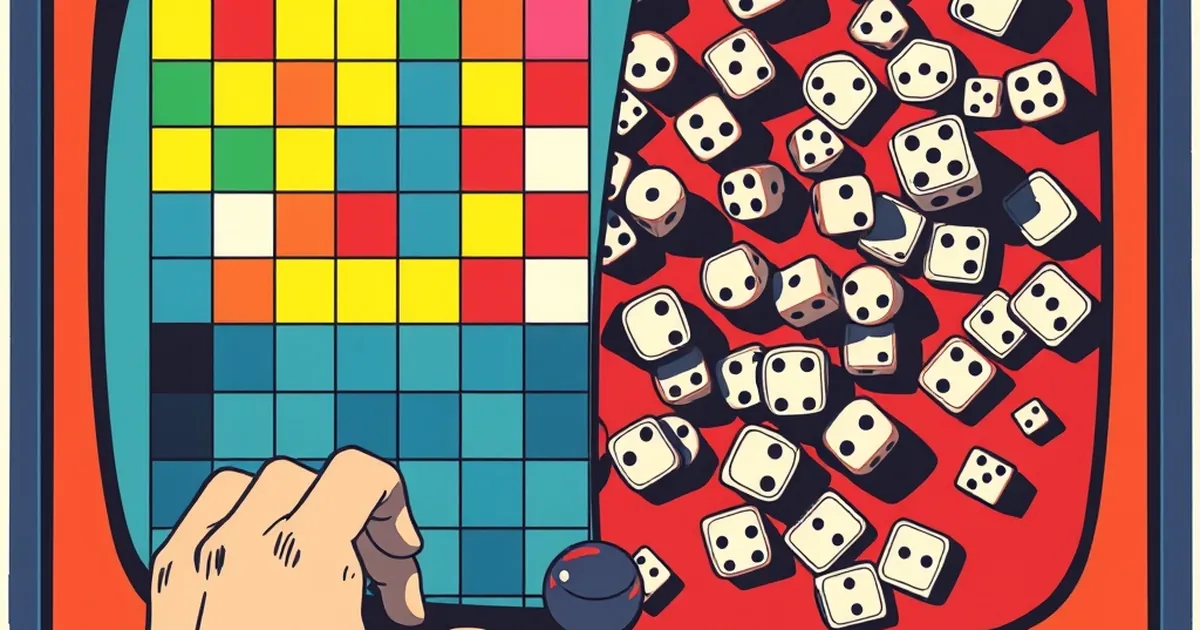
The design of a puzzle game hinges on a delicate balance between skill and unpredictability. Introduce too much structure, and the experience feels mechanical; inject too much chance, and players feel cheated. Game designers have long suspected there is a tipping point, and emerging research in behavioral psychology suggests that threshold sits at approximately 40% randomness—beyond which player retention drops off sharply.
The Cognitive Cost of Unpredictability
At its core, a puzzle game is a promise: if you learn the rules and apply logic, you can solve the challenge. The player invests cognitive effort in exchange for the satisfaction of mastery. When randomness exceeds a certain level, the connection between effort and outcome breaks.
This phenomenon aligns with a well-established concept from behavioral economics called effort justification. Coined by social psychologists Leon Festinger and James Carlsmith in the 1950s, the theory holds that people value outcomes more when they have worked for them. In a puzzle context, if a solution depends heavily on a random draw rather than pattern recognition or deduction, the player’s invested effort feels wasted. The brain registers this as a violation of a tacit contract, leading to frustration and abandonment.
The 40% Ceiling: What the Data Shows
Why 40% specifically? A 2019 study published in the journal Nature Human Behaviour examined player engagement across 2,700 mobile puzzle games. Researchers tracked drop-off rates against the proportion of levels that included a random element—such as a tile shuffle, a coin flip to determine block color, or a random power-up drop. The results were stark: games with randomness in 40% or more of their levels saw a 32% higher churn rate within the first week compared to those with randomness below 30%.
The key insight was not that randomness is bad, but that it becomes toxic once it crosses a threshold. Below 40%, players accepted occasional luck-based moments as spice. At 40% and above, the game stopped feeling like a test of skill and started feeling like a slot machine in disguise.
Variable-Ratio Reinforcement in Reverse
This connects to the work of psychologist B.F. Skinner and his research on variable-ratio reinforcement. Skinner demonstrated that unpredictable rewards—like a pigeon pecking a lever that occasionally releases a pellet—create the most persistent behavior. In gambling, this is the engine of addiction. But in puzzle games, the same mechanism backfires.
Players come to a puzzle game seeking agency, not operant conditioning. When the randomness is too high, the brain’s dopamine system treats the game as a gambling task, not a problem-solving one. The player experiences the same uncertainty as a slot player, but without the financial stake. The result is not engagement but anxiety. The player leaves not because the game is hard, but because it feels unfair.
The Successful Exception: Tetris as a Case Study
Consider the enduring appeal of Tetris. The game uses a random bag of seven piece shapes, but the randomness is tightly controlled. Each piece appears exactly once per bag before the bag reshuffles. This system ensures no player ever goes more than seven pieces without seeing the shape they need. The randomness is predictable—it operates within known boundaries.
Tetris’s randomness is effectively zero from a player’s perspective because the system is transparent and the skill ceiling is infinite. Players never blame the game for a loss; they blame their own timing and placement. This is the gold standard for puzzle design: randomness that feels like variety, not caprice.
Designing for the Future: The 30% Rule
Game developers looking to retain players past the first week would do well to adopt a 30% rule. Reserve randomness for power-ups, bonus items, or cosmetic variations—never for core progression mechanics. If a player must rely on luck to pass a level, that level should be an exception, not the norm.
A practical forward-looking approach is to implement adaptive randomness. The system can track a player’s success rate and dial down the random elements when they are on a losing streak. This mirrors the concept of loss aversion from Kahneman and Tversky’s prospect theory: players feel the pain of a loss twice as intensely as the pleasure of a win. Reducing randomness when a player is already frustrated prevents the cognitive breach that drives them away.
The next generation of puzzle games will succeed not by eliminating randomness, but by treating it like a spice—used sparingly, and never allowed to overshadow the player’s own intelligence.