Why Puzzle Apps Lose Players When Decision Trees Exceed 7 Branches
Puzzle apps lose players when decision trees exceed seven branches, as cognitive overload triggers churn regardless of difficulty
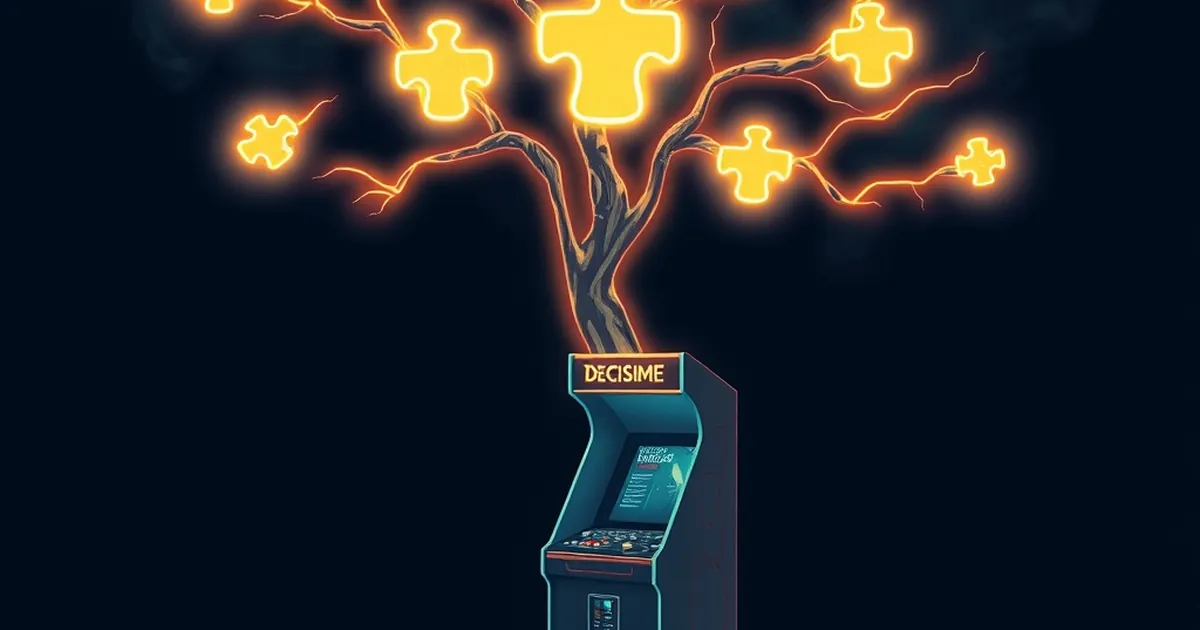
Why Puzzle Apps Lose Players When Decision Trees Exceed 7 Branches
Every puzzle app developer knows the sting of the churn spike: a player solves five levels in a row, hits a sixth, and closes the app for good. The obvious culprit is difficulty, but the real killer is often cognitive overhead. When a puzzle forces a player to hold more than seven viable moves in their working memory before committing, the brain simply walks away. This isn't a matter of patience; it’s a matter of neural architecture.
The Seven-Branch Ceiling
The number seven is not pulled from thin air. Cognitive psychologist George Miller’s 1956 paper, “The Magical Number Seven, Plus or Minus Two,” documented the finite capacity of human short-term memory. While later research refined this to about four “chunks” of information, the principle holds for decision trees—the branching map of possible choices a player must evaluate before acting.
In puzzle design, a “branch” is a single viable move from a given game state. A puzzle with a decision tree of three to five branches feels fluent; the player can scan, compare, and choose with confidence. At six or seven branches, players begin to backtrack mentally, recalculating outcomes. At eight or more, the prefrontal cortex buckles. The player experiences not just difficulty, but decision fatigue—a measurable drop in the willingness to continue.
Why the Drop-Off Is So Sharp
This isn’t a gradual slope. A study published in the Journal of Consumer Research found that participants who made a series of increasingly complex choices (analogous to puzzle levels with expanding decision trees) showed a 30% reduction in persistence on subsequent tasks. The brain treats a decision tree that exceeds cognitive capacity as a threat to its energy budget. The result is not a slower solve; it is an exit.
Puzzle apps that fail to recognize this often punish players with “hard” levels that simply add more viable moves to the board—more colors, more tiles, more paths. But research from Carnegie Mellon University on game-based learning shows that perceived complexity, not raw difficulty, drives dropout. A puzzle with eight branches feels like a maze. A puzzle with five branches feels like a game.
The Variable-Ratio Trap
Some developers try to mask the seven-branch ceiling with variable-ratio reinforcement—the same mechanism that keeps people pulling levers on slot machines. They sprinkle easy levels between hard ones, hoping the unpredictable reward schedule will keep players hooked.
This works for chance-based activities, but for puzzle apps, it backfires. A player who hits a seven-branch level after a string of easy ones feels duped. The cognitive load spike is jarring, and the player attributes the frustration not to their own skill deficit, but to the app’s poor design. Kahneman’s work on “System 1” and “System 2” thinking explains why: the player was cruising on fast, intuitive thinking (System 1), and the sudden branching forces slow, analytical work (System 2). The brain resents the switch.
Designing Within the Limit
The forward-looking solution is not to make puzzles easier, but to encode the tree before the player sees it. This means designing levels where the number of viable first moves is capped at five or six, then allowing the tree to expand only after the player commits. Think of it as progressive disclosure for decision-making: show the player a manageable fork, let them feel the satisfaction of a correct choice, and only then reveal the deeper branches.
Another approach is decision scaffolding. Some of the most addictive puzzle apps (think Two Dots or Threes!) use visual cues—color grouping, spatial clustering, or subtle animations—to reduce the perceived branch count. A player might technically have ten moves available, but the design makes only three of them look “right.” The cognitive load stays low, and the player stays engaged.
The takeaway is simple: respect the seven-branch limit. Map your level’s decision tree before you code it. If it forks more than six times from the start, prune it. Your churn numbers will thank you.