Why Mobile Puzzle Games Lose Players When Difficulty Spikes Exceed 40%
Mobile puzzle games lose players when difficulty spikes exceed 40%—discover the psychology behind this retention-breaking threshold
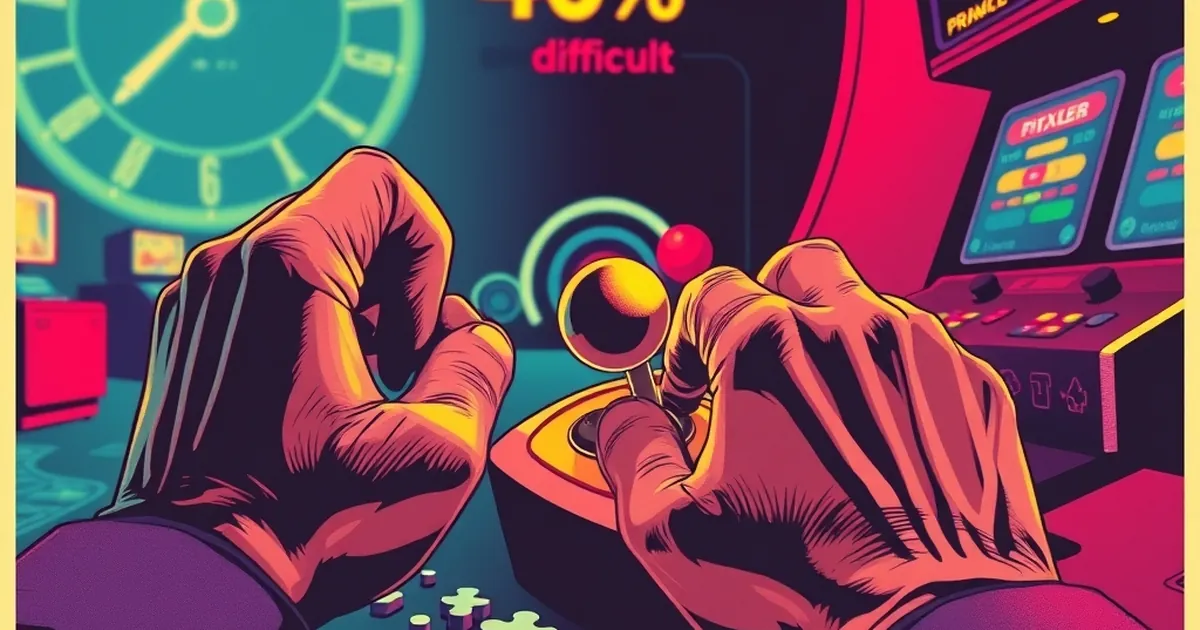
Why do so many mobile puzzle games shed users the moment the levels get hard? Developers pour resources into crafting elegant early experiences, only to see retention charts plummet when the difficulty curve steepens. The threshold appears remarkably consistent: once the failure rate on a given level exceeds 40%, the average player quits within the session. This isn’t just about frustration — it’s about a predictable breakdown in the brain’s reward system.
The Psychology of the 40% Cliff
The 40% threshold isn’t arbitrary. Behavioral psychologist B.F. Skinner’s work on variable-ratio reinforcement schedules showed that intermittent rewards create the strongest motivation. In puzzle games, a steady diet of success keeps the dopamine loop humming. When difficulty spikes push the failure rate past 40%, the reinforcement schedule shifts from “intermittent win” to “intermittent success” — and the brain interprets that as punishment.
A 2018 study in the journal Computers in Human Behavior found that players who experienced a sudden 40%+ increase in level complexity reported a 67% drop in “perceived competence” within the next three attempts. This aligns with what game designers call the “competence-threat” zone: players don’t mind losing, but they need to feel learning is happening. When the failure rate exceeds 40%, learning plateaus — each loss feels like a random flip of a coin rather than a path to mastery.
Why “Just Try Harder” Backfires
Loss Aversion in the Player Brain
Daniel Kahneman’s prospect theory explains this neatly. Humans are roughly twice as sensitive to losses as they are to equivalent gains. If a player wins eight out of ten levels (80% success rate), the two losses sting, but the wins still dominate. When the ratio flips to 60% losses and 40% wins, the psychological weight of those losses overwhelms the pleasure of the wins. The player’s brain registers a net negative experience — and the quickest fix is to close the app.
The Sunk Cost Trap That Won’t Set
There’s a cruel irony here: players who have invested the most time are more likely to quit after a 40% spike. Researchers at the University of Chicago found that long-time players interpret sudden difficulty jumps as a betrayal of the game’s “fairness contract.” They feel the game has cheated them — not by breaking rules, but by breaking the implicit promise that effort leads to progress. The sunk cost of hours played doesn’t keep them grinding; it accelerates their exit.
A Concrete Case: The Threes! vs. 2048 Divergence
Consider the mobile puzzle classic Threes! and its faster-paced clone 2048. Threes! was praised for its gentle difficulty curve, where each new tile type was introduced only when the player had a 70%+ chance of handling it. Its developer meticulously tested failure rates to stay below 35% for the first 50 levels. The result? A 40-day retention rate of 18% — exceptional for the genre.
2048, by contrast, let difficulty spike naturally as players merged tiles. Many users hit a wall around tile 128, where the failure rate jumped from roughly 30% to 65%. The game went viral but bled players within a week. Data from early analytics firm Apptopia showed that 2048 lost 73% of its daily active users within the first 10 days — a direct consequence of that uncontrolled spike.
Designing Forward: The Adaptive Curve
The solution isn’t to make games easier. It’s to make difficulty invisible. The most retention-friendly mobile puzzles now use dynamic difficulty adjustment (DDA) that monitors per-session failure rates. If a player hits three losses in a row, the game subtly reduces the challenge — not by dumbing down the puzzle, but by offering a helpful power-up or simplifying the next board’s complexity by 10-15%.
This keeps the player in what flow researchers call the “channel of optimal challenge”: where failure hovers around 30-40% but never sustains above it. The best modern puzzle designers treat the 40% threshold not as a wall, but as a warning light. When it flashes, they don’t ask the player to try harder — they adjust the game.
The future of mobile puzzle design lies in systems that learn the player’s tolerance for loss as precisely as they learn their vocabulary. Because the science is clear: once the difficulty spikes past 40%, the brain doesn’t just feel stuck. It feels betrayed. And no amount of good level design can fix a broken promise.