Why Arcade Cabinets Lost Players When Win Rates Dropped Below 30%
Discover why arcade players abandoned cabinets when win rates fell below 30%, revealing the psychological limits of skill-based reward systems
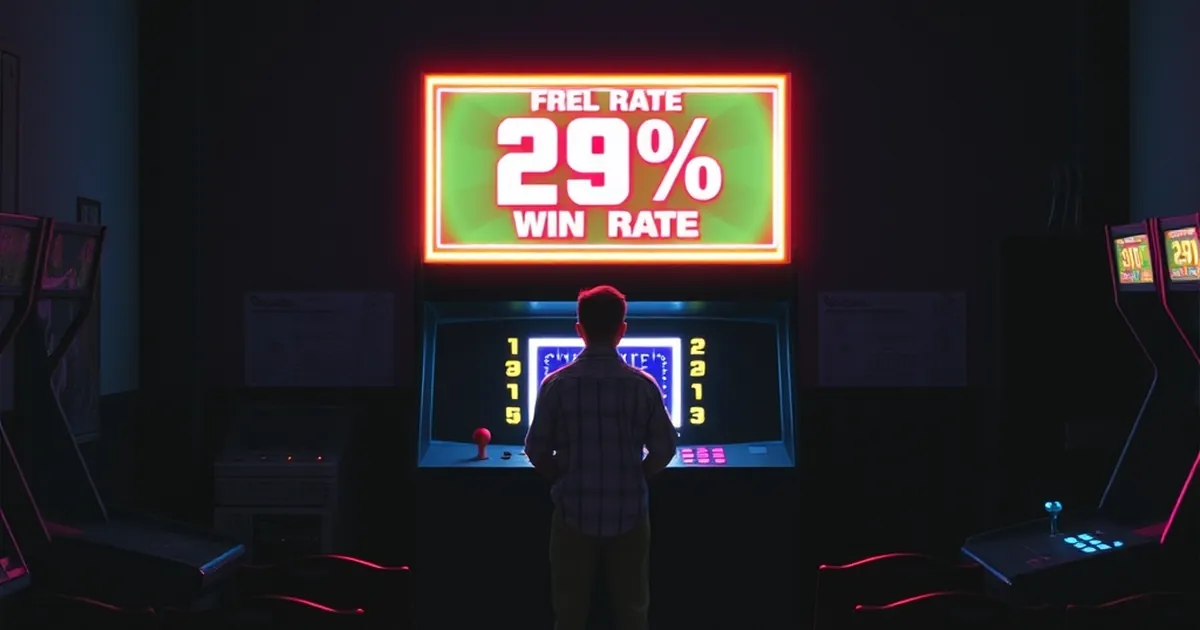
The golden age of the arcade was built on a fragile psychological contract. For a quarter, a player entered a world of perfect feedback loops, where skill and timing could produce a cascade of lights and sounds. But by the late 1980s, something shifted. Operators, squeezed by rising costs and shrinking margins, began tweaking the "factory" settings on their machines. The result was a mass exodus of casual players. The question isn't just why they left, but what that specific threshold—a win rate dipping below 30%—reveals about the human brain's tolerance for uncertainty.
The 30% Cliff: Where Skill Meets Despair
Behavioral research, particularly the work of psychologist B.F. Skinner, offers a stark framework here. Arcade games operate on a variable-ratio reinforcement schedule, where rewards come after an unpredictable number of responses. This is the most addictive schedule known to psychology—slot machines use it. But arcade games have a critical difference: they promise the illusion of control. You can dodge the bullet. You can time the jump.
When the difficulty curve is calibrated correctly, the player feels a "near miss" as a learning opportunity, not a failure. However, once the win rate (or successful survival rate) drops below roughly 30%, the brain stops interpreting the feedback as "I can improve." It shifts to "this is random punishment." A 2005 study by Dr. Luke Clark at the University of Cambridge demonstrated that near-misses in skill-based tasks actually activate the brain's reward circuitry more than wins—but only when the player believes they have agency. Below a 30% success rate, the brain stops encoding near-misses as progress and starts encoding them as pure loss. The arcade cabinet, once a temple of agency, becomes a slot machine with a joystick.
The Death of the "Just One More Go" Loop
The core appeal of a classic cabinet like Pac-Man or Donkey Kong was the "one more try" effect. Each death felt like a personal failure that could be corrected. This is the opposite of loss aversion, the behavioral economics principle that losses hurt roughly twice as much as equivalent gains feel good. When the win rate is high (say, 40-50%), the player frames each quarter as a low-cost investment in future mastery. The "loss" of a quarter is easily offset by the "gain" of surviving another 30 seconds.
But at a 27% win rate, the math in the player's head inverts. Every quarter is now a probable loss. The brain, governed by the amygdala, begins to flag the machine as a threat. The social aspect of the arcade—watching a friend play for five minutes—also collapses. Spectatorship only works when the player demonstrates competence. When everyone is dying in the first 20 seconds, the crowd disperses. The cabinet becomes a silent, lonely box that takes money without giving back the dopamine hit of incremental progress.
The Modern Echo: Game Design's Hard Lesson
This isn't just a history lesson. The 30% threshold is now a standard benchmark in modern game design for "flow state." Developers of competitive games like Street Fighter or Overwatch explicitly design their matchmaking and difficulty curves to keep players in a 40-60% win range. Drop below 30%, and the churn rate spikes. The arcade industry learned this the hard way: by the early 1990s, the most successful new cabinets—Street Fighter II, Mortal Kombat—weren't harder. They were fairer. They gave the player a clear, achievable path to mastery, even if the final boss was brutal.
What Operators Can Learn From the Crash
The fix isn't to make games easier. It's to make the feedback loop transparent. The next time you design a challenge—whether for a product, a training module, or a game—ask yourself: does the user feel a 70% chance of failure or a 30% chance of success? The difference is semantic, but the brain reads it as a canyon. Give the player a clear indicator of progress (a health bar, a timer, a score multiplier) before they lose. Let them see the shape of their failure. That single change—making the loss feel like a data point rather than a punishment—is what separates a cabinet that empties pockets from one that builds a queue. The quarter was never the real currency. The belief that you could get better was.