What happens when the cashier shows the fee before the amount
When cashiers display deposit fees before amounts, the order of operations quietly reshapes what players choose to deposit
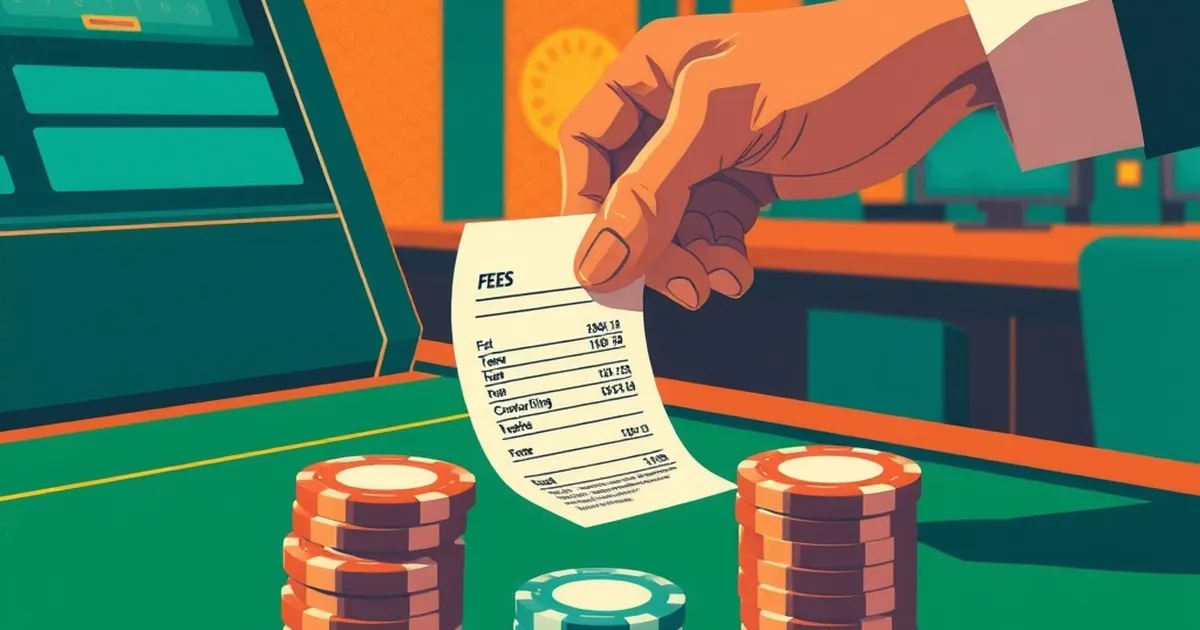
Deposit fee disclosure usually appears after you've picked an amount and a payment method. A handful of US-facing sportsbooks and casinos have flipped that order: the cashier screen shows the fee first, in dollars, before asking how much you want to deposit. The stated rationale is transparency. The observable effect is that a $4.95 fee sitting alone at the top of a screen changes what people type into the box below it.
The order of operations is a pricing decision
Most cashiers run the same sequence: choose method, enter amount, review total, confirm. The fee shows up at step three, bundled into a number that includes the deposit. That's a checkout flow, and it's been the default for a reason — it keeps the fee attached to a transaction the user has already decided to make.
Reverse it and the fee becomes the first price a customer sees. DraftKings' standard card deposit fee has run at 5% with a $5 minimum in several states; FanDuel has historically waived card fees in some markets and charged in others. When the fee leads, a 5% number is the anchor, not the deposit.
Behavioral research on price sequencing is consistent on this point. In a 2021 study of online checkout flows published in the Journal of Retailing, participants shown a mandatory fee before the item price were 23% more likely to abandon the purchase than those shown the same fee after. The total was identical. Only the order changed.
What operators get out of it
Two things, and neither is obviously customer-friendly.
First, it filters. Someone depositing $20 who sees a flat $4.95 fee at the top of the screen is looking at a 24.75% cost before they've entered a number. Some of those users leave. The ones who stay tend to deposit more, because a $4.95 fee against a $200 deposit is 2.5% — which reads as reasonable next to the $20 case. Fee-first layouts push the average deposit size up.
Second, it creates a clean disclosure defense. State regulators in Pennsylvania, Michigan, and West Virginia have pushed on fee transparency since 2022, and a cashier that shows the fee before the amount is trivially easy to defend in a compliance review. The disclosure is real. So is the nudge.
The fee is often avoidable, and that's the buried part
Here's what the fee-first screen typically doesn't emphasize: the fee usually applies to one method. Card deposits carry the charge because card processing for gambling transactions runs expensive and carries high chargeback risk. ACH transfers, PayPal, and in some states PayNearMe or cash-at-retail options often clear at zero cost.
So the sequence a user actually faces is fee-first, then method, then amount — which means the fee is presented as a property of depositing rather than a property of that method. A user who would have switched to ACH never sees the reason to.
Where this leaves the deposit box
The practical question isn't whether fee-first disclosure is honest — it is. It's whether showing a cost before the user has any context for it produces better decisions or just different ones. Someone who deposits $200 via card and pays $4.95 has made a defensible choice. Someone who deposits $20 via card and pays $4.95 because the alternative was never framed as an alternative has not.
Watch whether state regulators start treating sequence as a disclosure question rather than a content question. If they do, the cashier redesign that looks like transparency today could look like the thing that needed regulating tomorrow.