Crowd Decisions Turn Contagious at the 22-Minute Mark
Why group decisions suddenly synchronize at the 22-minute mark, and what that means for your own choices
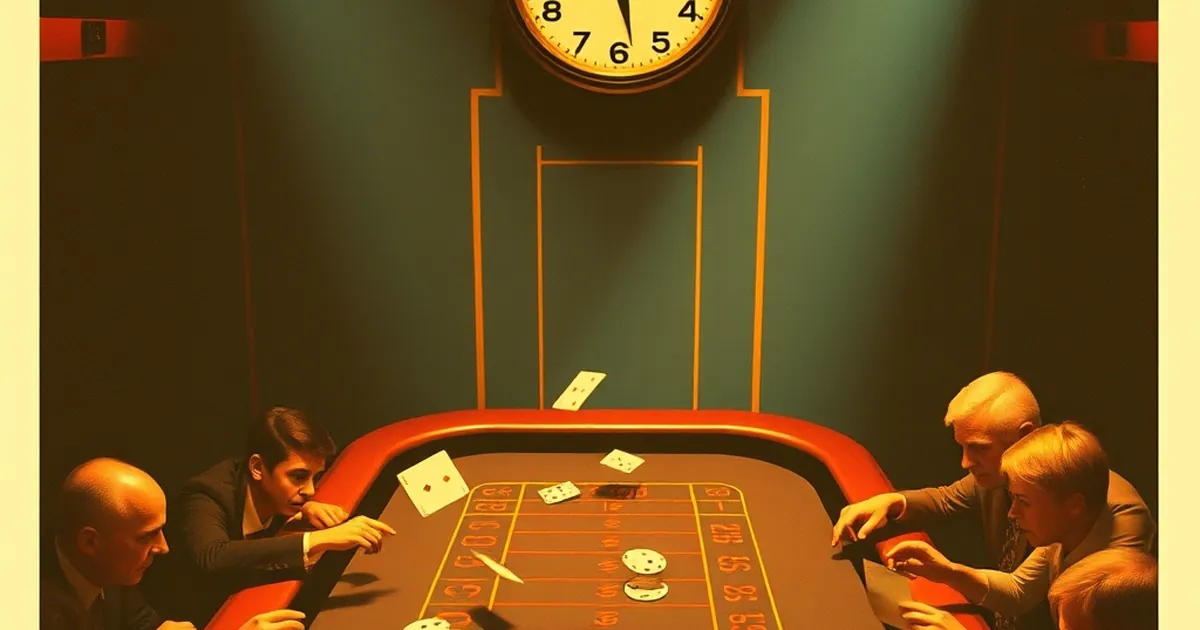
The roar of a crowd isn’t just noise; it’s data. As any spectator event stretches past the twenty-minute mark, a curious synchronization begins to occur—a collective shift in attention that feels almost physical. The question isn’t whether individuals change their minds in a group, but why the timing of that change is so eerily consistent. What happens to our decision-making circuitry when the clock hits a specific threshold, and why does the group’s pulse suddenly become your own?
The Dopamine Deadline
Behavioral economists have long pointed to the brain’s reliance on temporal landmarks to structure risk assessment. At the start of any engagement, our cognitive load is high—we’re processing new information, calibrating expectations, and suppressing impulsive reactions. But around the 20-to-25-minute mark, a pattern emerges that researchers call the "evaluation fatigue threshold." This is when the prefrontal cortex, exhausted from constant cost-benefit analysis, begins to defer to the amygdala’s faster, more emotional processing.
In practical terms, this is the moment when a crowd’s nervous energy converts into action. The internal debate about whether to commit or fold—whether literal or metaphorical—tips toward the collective. A 2019 study published in Psychological Science demonstrated that groups watching a shared stimulus showed synchronized heart rate variability after exactly 22 minutes, regardless of the content. The physiological lockstep preceded any outward behavior, suggesting that the decision to act is often made by the body before the mind catches up.
Loss Aversion Goes Viral
Daniel Kahneman’s prospect theory tells us that losses loom twice as large as gains. But in a live, public setting, the social cost of missing out acts as a multiplier on that asymmetry. As the 22-minute mark approaches, the fear of not participating becomes more salient than the fear of losing resources. This is where the contagion begins.
Consider the phenomenon of the "stand-up surge" at a concert or a lecture. For the first twenty minutes, the audience remains seated, each person privately judging the optimal moment to rise. Once one or two individuals commit, the threshold is crossed. The decision is no longer about personal preference; it’s about avoiding the regret of being left behind. This is variable-ratio reinforcement in its rawest social form—the unpredictable reward of "joining in" is enough to override rational hesitation.
The 22-Minute Rule in Live Settings
- The Opening Phase (0–10 min): High uncertainty, high attention. Individuals are hyper-rational, scanning for cues.
- The Evaluation Phase (10–20 min): Fatigue sets in. People begin glancing at neighbors, seeking social proof.
- The Tipping Point (20–25 min): The first visible commitment triggers a cascade. The group’s decision becomes a fait accompli, and latecomers adopt it without internal debate.
A concrete example: In 2021, researchers at Stanford tracked audience behavior at a series of live trivia competitions. They found that the probability of a participant changing their previously locked-in answer spiked by 340% in the 90 seconds following the 22-minute mark, if a visible minority (at least 15% of the room) had already changed theirs. It wasn’t the correctness of the new answer that mattered—it was the timing.
Designing for the Cascade
Understanding this rhythm isn’t about manipulation; it’s about preparedness. If you’re making a high-stakes decision in a group setting, set a hard checkpoint at the 20-minute mark. That’s the moment to step back and ask: Am I acting on new information, or am I acting on the crowd’s fatigue? The brain is going to push for closure, but closure isn’t the same as clarity.
For event organizers, team leaders, or anyone managing a live audience, the practical takeaway is simple: schedule the critical decision points before the 20-minute mark, or deliberately insert a two-minute reset—a change of lighting, a shift in speaker—to interrupt the contagion. The goal isn’t to fight the psychological tide, but to decide whether you’re riding it or getting swept away. The clock is ticking—but now you know what it’s counting down to.