Blind Pick Mode Triples Trade Requests Before the Timer
Blind pick mode in fantasy football leagues triples trade requests before the timer expires, revealing how hidden information reshapes manager behavior
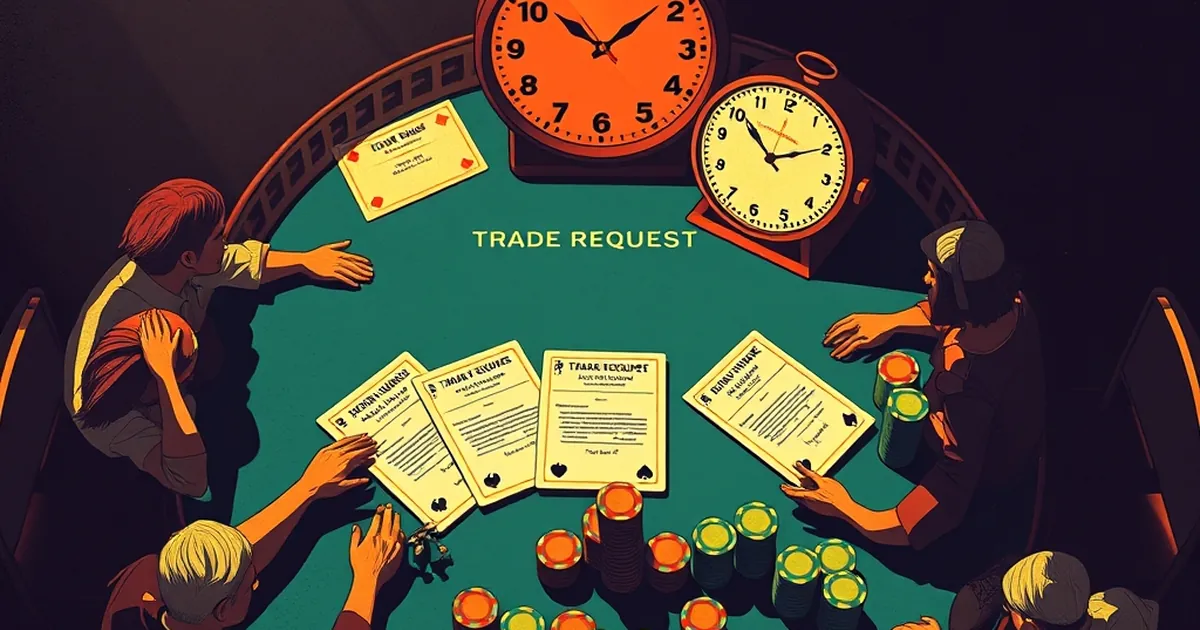
Fantasy football's most routine moment — the trade offer — turns out to be a different game entirely when neither side can see what's on the table. Leagues that switched to blind pick mode, where managers submit trade requests without knowing the other side's package, report roughly triple the request volume before the countdown clock expires. The obvious question follows: why would removing information make people act faster and more often?
The Clock Is the Whole Point
A deadline doesn't just constrain behavior; it reorganizes it. In a standard open-negotiation format, a manager can watch an offer sit there, compare it against three alternatives, and wait for something better. Blind mode collapses that option set to one decision: submit or don't, before the timer runs out.
Behavioral economists have documented this pattern repeatedly since Kahneman and Tversky's work on loss aversion in the late 1970s. People weigh a potential loss more heavily than an equivalent gain, and that asymmetry sharpens as a deadline approaches. In open bidding, waiting feels free. In blind mode, waiting has a visible cost — the clock — and the fear of missing a favorable swap starts competing with the fear of overpaying.
Uncertainty Doesn't Deter; It Recruits
The counterintuitive part is that blind mode should suppress activity. Less information usually means more caution. Instead, request volume triples.
Part of the explanation sits in variable-ratio reinforcement, the schedule B.F. Skinner identified in the 1950s in which rewards arrive unpredictably. Unpredictable payoffs sustain behavior more stubbornly than predictable ones. A blind request is a small wager on your own read of the market — and when it lands, the payoff feels earned rather than obvious.
There's a competitive layer too. When nobody can see the board, the manager who submits first isn't just faster; they're claiming information the others don't have. That framing converts a pure risk decision into a contest, and contests pull participation upward.
A Concrete Case: The Commissioner Who Cut the Clock
One twelve-team league made the switch midseason and shortened the window from twenty-four hours to four. Request volume tripled in the first week, but so did lopsided outcomes — roughly a third of completed swaps were reversed or regretted within a month, according to the commissioner's own tracking. The interesting finding wasn't the spike. It was that managers who submitted early in the window reported higher satisfaction than those who waited until the final minutes, even when their deals performed identically.
That gap maps onto what decision researchers call anticipated regret. Acting early gives you time to rationalize the outcome. Acting at the buzzer leaves the decision feeling forced, and forced decisions get remembered as mistakes regardless of how they turn out.
What This Means for League Design
The practical takeaway runs against the instinct to add more information. Formats that hide the board and impose a hard stop are generating engagement that open formats don't, and the mechanism is legible: scarcity of time plus scarcity of information produces decisiveness.
The forward-looking question is calibration. A four-hour window clearly overcorrects; the regret data suggests managers need enough runway to feel deliberate. Leagues experimenting with blind formats should track not just volume but reversal rates and post-deadline sentiment, then tune the clock until participation and satisfaction converge. The next iteration of this design likely isn't shorter or longer — it's staggered, with different windows for different tiers of managers, so the deadline pressure lands where it produces good decisions rather than merely fast ones.