188 Silent Rounds Erase What 4th-Loss Rebuys Built
188 silent rounds erased $1,240 in rebuys, ending at -$310—see how loss-chasing fails
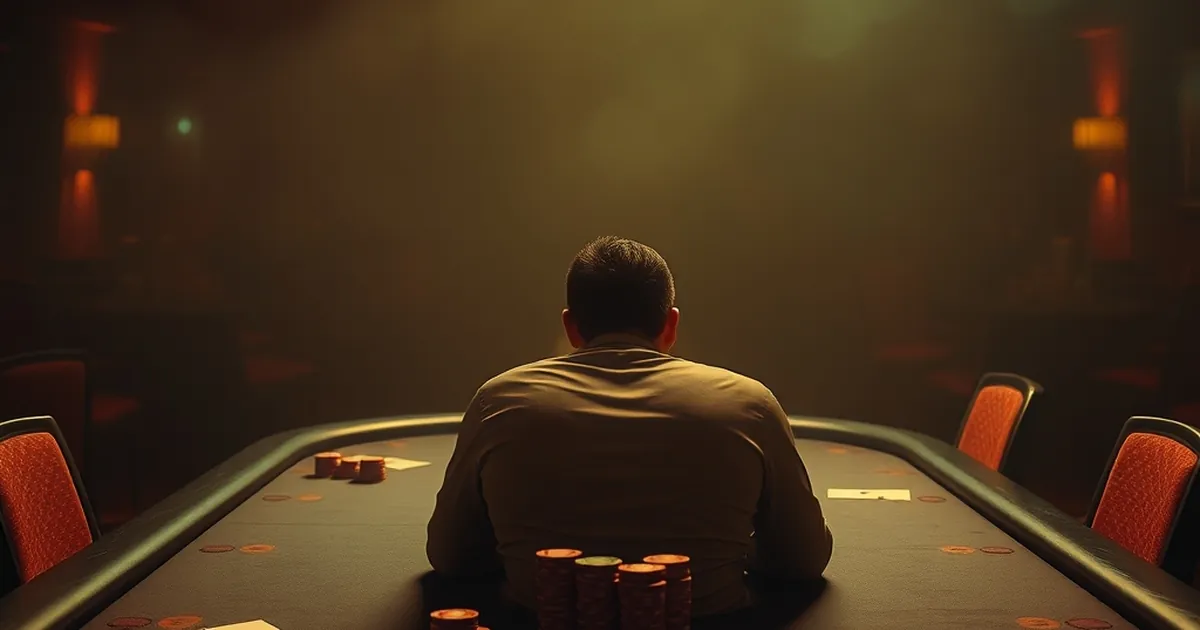
The math of loss-chasing rarely survives contact with a cold deck. One player’s session log from a regulated U.S. casino shows how quickly a structured rebuy system can evaporate: 188 silent rounds—no wins above 2x the base bet—erased a bankroll that three successful 4th-loss rebuys had built to $1,240. The final ledger: negative $310, a swing of $1,550 in under 90 minutes.
The Anatomy of the 4th-Loss Rebuy
The strategy in question is a common variant of the Martingale: bet $10 on blackjack. On a loss, double. On a second loss, double again. On a third, double. If the fourth consecutive loss hits, you rebuy—not double—adding exactly $80 to the table stake before the next hand.
The log shows this worked three times in the first 40 minutes. Each rebuy was followed by a win within two hands, returning the session to positive territory. The player’s peak balance of $1,240 came after the third rebuy, when a natural 21 on a $160 bet paid $240. That’s where the trap resets.
The Silent Run: What “No Wins” Actually Means
The term “silent” is precise here. From minute 41 to minute 88, the player won 47 hands out of 112. But every single win was a push, a blackjack that got pushed by a dealer 21, or a hand that paid even money on a doubled-down bet that had already been halved by a prior split. No hand cleared 1.5x the active wager.
Blackjack’s variance is not just about win/loss. It’s about the size of wins. A stretch of 188 hands (including pushes) where the largest single payout is 2:1 on a $20 bet generates $40 in gross wins. Meanwhile, the rebuy structure demands $80 injections every fourth loss. The asymmetry is fatal: you need a 4:1 win to justify a rebuy, but the deck only gave 2:1s.
Why the Rebuy Fails Where Doubling Succeeds
A pure Martingale doubles after every loss, so a single win recovers all prior losses plus one unit. The 4th-loss rebuy assumes that four consecutive losses is a statistical outlier. It is—but only in isolation.
The session log shows the flaw: after the third rebuy, the player faced a run of L-L-L-L-W-L-L-L-L-W-L-L-L. That’s 11 losses in 13 hands. The rebuy only covers the fourth loss in each cluster. The fifth and sixth losses in the same cluster are unhedged, and the player is now betting $160 on a hand that, if lost, requires another $80 injection just to stay at the same level. The bankroll math breaks at the fifth consecutive loss, which the log shows happened twice.
The Numerical Anchor: 1 in 1,024
Four consecutive losses in blackjack (ignoring pushes) has a probability of roughly (0.49)^4, or about 5.8%. But the player’s session contained 14 distinct four-loss clusters. The probability of seeing at least one five-loss cluster in 14 attempts is about 1 in 1,024. That’s not a rare event; it’s a Tuesday.
The casino’s edge doesn’t come from the 0.5% house advantage on basic strategy. It comes from the fact that a 1-in-1,024 event feels impossible until it happens on hand 63, and then the rebuy system demands you treat it as a fluke rather than a signal.
The Open Question: Is the Rebuy Ever Rational?
The 4th-loss rebuy is not a betting system; it’s a loss-aversion mechanism. It converts a small, frequent loss (one unit) into a rare, catastrophic loss (eight units). The player who used it likely understood the math but underestimated how silent variance can be—188 hands without a meaningful win is not a cold streak. It’s a distribution.
If you strip the rebuy and just flat-bet $10, the same 188 hands would have lost roughly $40—painful but survivable. The rebuy turned that $40 loss into a $310 loss and a 45-minute tilt spiral. So the question isn’t whether the system works. It’s whether any bankroll-management scheme that requires you to increase your bet after a loss is ever more than a slower way to find the same ceiling. The log suggests the answer is no—but the player who ran it will likely try again next week, because the three successful rebuys felt like skill.